Dust and air quality
This page follows dust and air quality through the Tenas mine file from 2018 to 2026: what the company predicted, what the province's air reviewer and residents said about it, and what has been promised since.
In brief
The company's own chapter says "Dust is one of the top concerns of the local community". The file holds one air study, filed in May 2022. It predicts that the mine would put about 950 tonnes of dust into the air in its busiest year, most of it from haul roads, and that the mine would cause no new breach of provincial limits at any home. It rates the effect "Not Significant" with "High" confidence. The Ministry of Environment's air reviewer answered that the modelling was "too uncertain to make a concrete determination". The company then made a list of promises. Nothing in the file after 2022 changes the study. Source: Application, Atmospheric Environment chapter, May 2022, p. 39; Application, Atmospheric Environment chapter, May 2022, p. 71; Reviewers' tracking table, comment 271.
The first three figures are the company's. The count of comments is ours, from the Environmental Assessment Office's tracking table of April 10, 2024.
The air today
The Bulkley Valley already has a particle problem, and the company's chapter says so. The fine particles that reach deep into the lungs are called PM2.5 (particulate matter smaller than 2.5 micrometres). The coarser, breathable dust is called PM10. In Telkwa the newer of two instruments recorded PM2.5 above the provincial objective on 7.9% of days. The chapter names wood smoke in winter and road grit in spring as the main causes. Source: Application, Atmospheric Environment chapter, May 2022, p. 37.
The company acknowledged to the Ministry of Environment that the mine sits in an air zone the province rates red, its worst class, for PM2.5. Source: Reviewers' tracking table, comment 240.
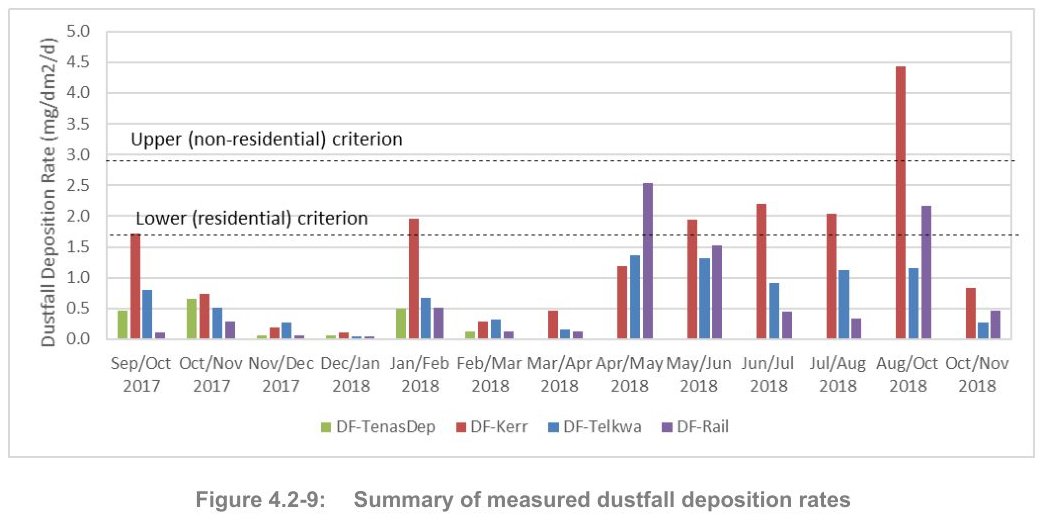
From September 2017 to November 2018 the company also set out open jars to catch settling dust at four places. The jar beside Telkwa Coalmine Road, 14 metres from the gravel, caught the most. Source: Application, Atmospheric Environment chapter, May 2022, p. 39.
What the file says, year by year
| When | What was filed |
|---|---|
| Nov 2018 | The company's first description of the mine lists open coal stockpiles "with dust mitigation", covered coal trucks, and about one 116-car coal train a week. It promises that "An air quality and dust control management plan will be in place prior to the start of construction". Source: Project Description, Nov 2018, p. 43; Project Description, Nov 2018, p. 45; Project Description, Nov 2018, p. 47. |
| May 2020 | The Ministry of Environment's air reviewer comments on the draft list of studies: "A detailed and robust fugitive dust management plan will be essential for this project". (Fugitive dust is dust that escapes from roads, piles and blasts, as distinct from smoke out of a stack.) The reviewer adds that dust jars are no longer accepted as a measure of particles in the air. Source: Reviewers' comments on the draft study requirements, 2020, p. 10; Reviewers' comments on the draft study requirements, 2020, p. 11. |
| May 2022 | The company files its application. The air chapter and its modelling report are the only air study in the file. They are described in the next two sections. |
| Jun to Jul 2022 | The public comments. By our keyword count, 121 of 537 submissions mention dust or air. The community group What Matters in Our Valley writes: "Your air is bad so you don't have to worry if we make it worse?" Source: Public comments 1 to 559 with company replies, Nov 2022; What Matters in Our Valley, comment to the Office, Jul 21, 2022, p. 13. |
| Jun to Nov 2022 | The Ministry of Environment's air reviewer files 52 comments and follows them up twice. The company answers each one and makes the promises listed below. |
| Aug 2022 | The company answers a request from the Town of Smithers with slides of photographs from a coal loadout in Colorado, a mine and a barge loadout in Alabama, and the Trend mine at Tumbler Ridge. The captions point to a "lack of dust" around them. The slides hold no measurements. Source: Company slides for the Town of Smithers, Aug 11, 2022. |
| Mar to Jul 2024 | What Matters in Our Valley writes that the Environmental Assessment Office cancelled a series of meetings arranged with the group. The group sends its questions on air, dust and noise in writing instead. Source: What Matters in Our Valley, statement on air, dust and noise, 2024. |
| Mar 2025 | The company replies with a letter from Ausenco, the consultant behind the 2022 chapter. The letter defends the 2022 study and reports no new modelling. Source: Company response on air and noise, Mar 5, 2025, p. 10. |
| Jul 2026 | The company's water response repeats the 2022 list of dust measures, among them: "Use dust supressing agents on the rail cars". Source: Water response, Part 4 of 9, Jul 9, 2026, p. 326. |
What the company predicts
The study models one year: the fifth year of mining, which the company calls the peak. It estimates the dust from every activity, subtracts what its dust controls are assumed to stop, and runs the remainder through a computer model of the valley's winds. Source: Application, Atmospheric Environment chapter, May 2022, p. 49.
Where the dust would come from
| Source | Tonnes of dust a year | Share |
|---|---|---|
| Trucks raising dust on haul roads and the coal haul road | 546 | 57% |
| Bulldozers | 241 | 25% |
| Wind on the coal stockpiles | 52 | 5% |
| Road graders | 43 | 4% |
| Blasting | 40 | 4% |
| Everything else, among it the processing plant (2.8) and the rail loadout (0.5) | 28 | 3% |
| All sources | 950 |
Dust of all sizes, which the report calls total suspended particulate. Of the 950 tonnes, 279 are PM10 and 29 are PM2.5. The shares and the last row above the total are our arithmetic. The table does not separate coal dust from rock and road dust. Source: Air Quality Modelling Report, Appendix 4.1-B, May 2022, p. 18.
Where it would land
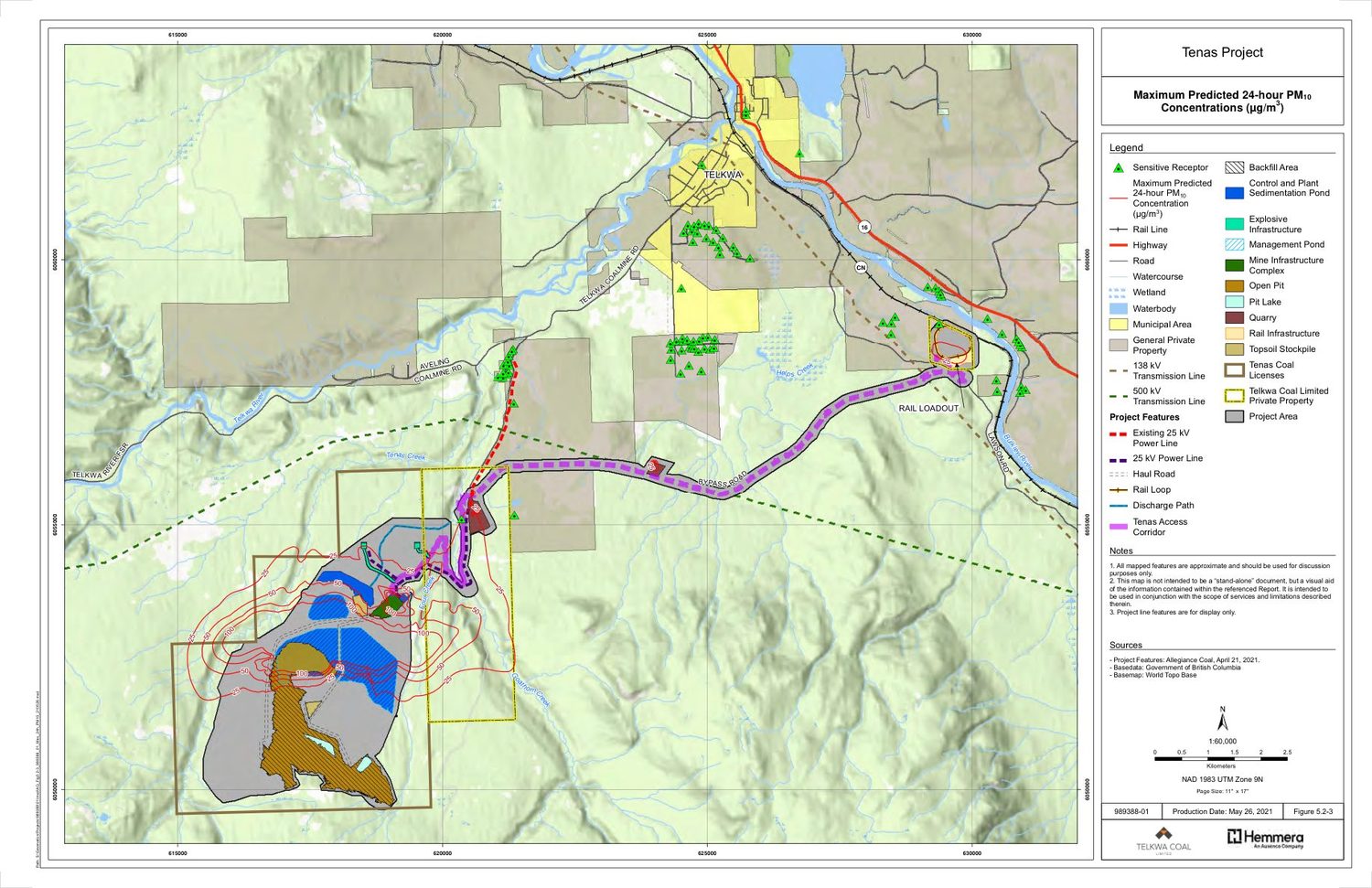
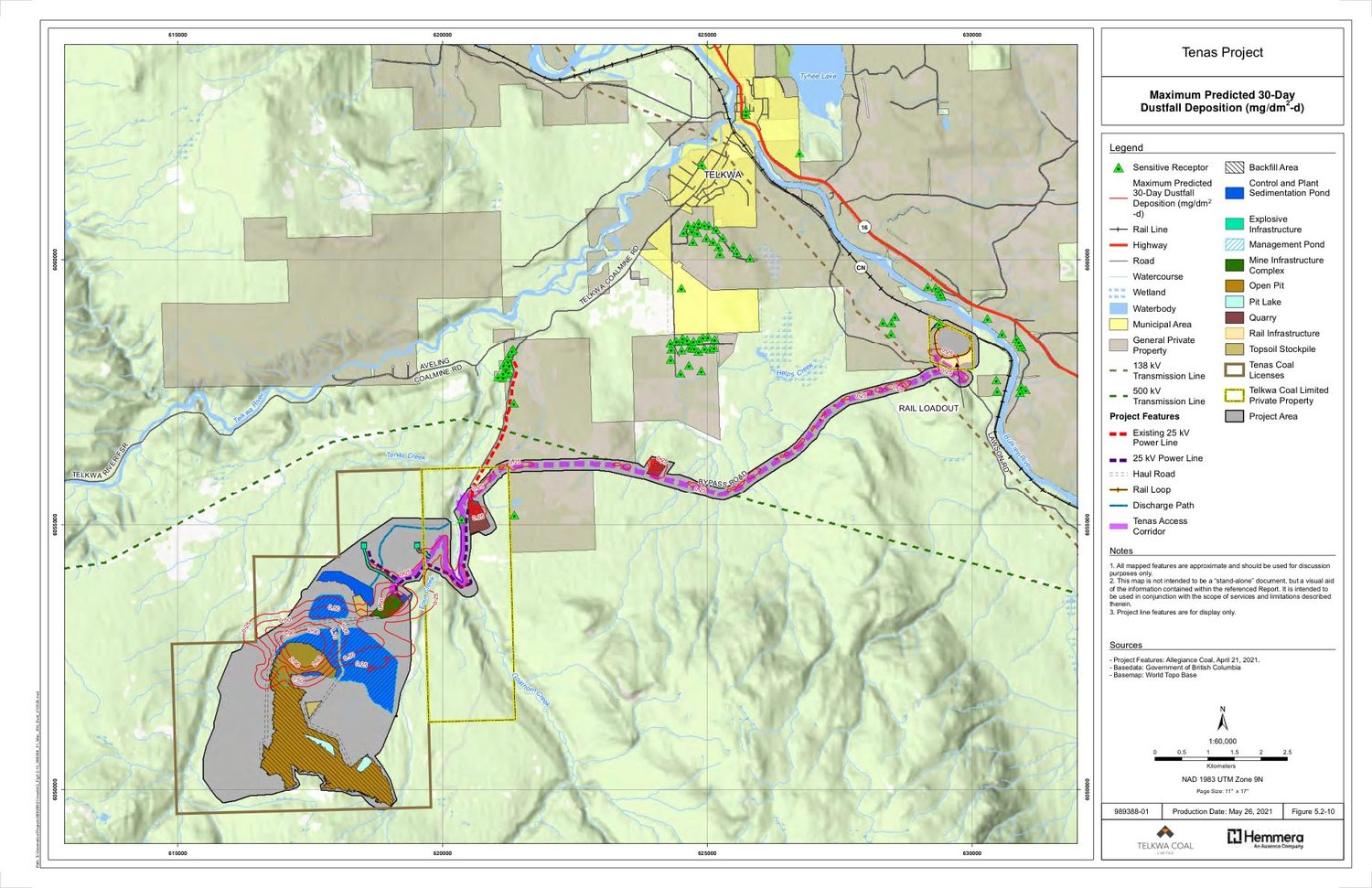
The study predicts that particles would exceed provincial objectives around the pit, the plant and the haul roads, "out to approximately 3 km southeast" of the mine. It predicts no new breach of an objective at any place where people live. Source: Application, Atmospheric Environment chapter, May 2022, p. 49.
| Worst day, with today's air added in | Telkwa | Recreation camp | Nearest home | Highest anywhere | Objective |
|---|---|---|---|---|---|
| PM10 | 57.8 | 40.2 | 26.1 | 439 | 50 |
| PM2.5 | 34.4 | 14.5 | 12.4 | 63.7 | 25 |
| All dust | 115 | 72.9 | 54.9 | 896 | 120 |
| Of which the mine adds | |||||
| PM10 | 1.5 | 25.0 | 10.9 | 424 | |
| PM2.5 | 0.4 | 4.3 | 2.2 | 53.5 | |
| All dust | 2.2 | 39.0 | 21.0 | 863 |
Micrograms per cubic metre of air, averaged over 24 hours, from Table 5.2-1 of the chapter. Red figures are over the objective. The recreation camp is the Telkwa Coalmine Recreation Camp, a horse riders' camp beside the coal haul road. Source: Application, Atmospheric Environment chapter, May 2022, p. 50.
Two things stand out in that table. Telkwa is over the objectives before the mine adds anything, and the mine's predicted share there is small. At the recreation camp and the nearest home the picture is reversed: the air stays under the objectives, and the mine is a large part of it. At the camp the mine would add 25.0 to a PM10 background of 15.2, so most of the dust in the air there on the worst day would be the mine's. The chapter itself says the change is "above 50% of baseline at the TCRC and the nearest residences". Source: Application, Atmospheric Environment chapter, May 2022, p. 41; Application, Atmospheric Environment chapter, May 2022, p. 70.
What the predictions rest on
The 950 tonnes is what remains after the study credits the dust controls. Each credit is an assumption taken from a handbook. Source: Air Quality Modelling Report, Appendix 4.1-B, May 2022, p. 12; Air Quality Modelling Report, Appendix 4.1-B, May 2022, p. 14.
- Watering the mine roads every day stops 75% of their dust. The report says watering happens "during favourable (i.e., non-freezing) weather conditions". The Ministry's reviewer asked about winter. The company answered that it has chosen agents that work down to minus 25 degrees and can cut truck speed to 30 km/h. Source: Air Quality Modelling Report, Appendix 4.1-B, May 2022, p. 14; Reviewers' tracking table, comment 267.
- A chemical binder on the coal haul road, applied once a year, stops 80%. In front of the recreation camp the binder is applied daily and credited with 98%.
- Watering the coal stockpiles by hand stops 50% of wind-blown dust.
- The waste rock piles give off no wind-blown dust. The report expects that winds "will not be strong enough to pick up and entrain dust particles" from them. Source: Air Quality Modelling Report, Appendix 4.1-B, May 2022, p. 11.
- One year of weather stands for all years. The model uses the winds of 2015. Source: Air Quality Modelling Report, Appendix 4.1-B, May 2022, p. 20.
- The coal trains are left out once they move. The report counts 66 trains a year idling at the loadout. Of the journey it says: "such emissions are attributable to Canadian National Railway rather than the Project". Source: Air Quality Modelling Report, Appendix 4.1-B, May 2022, p. 12; Air Quality Modelling Report, Appendix 4.1-B, May 2022, p. 13.
On these assumptions the chapter rates the effect on air quality "Not Significant", and adds: "The Level of Confidence is High". Source: Application, Atmospheric Environment chapter, May 2022, p. 71.
What the Ministry's air reviewer said, and what changed
The Ministry of Environment's air quality reviewer did not accept that confidence. On the chapter's conclusion the reviewer wrote: "Modeling is too uncertain to make a concrete determination." And on the rating: "Modeling for fugitive sources has high levels of uncertainty. Effects could be greater than anticipated." The company agreed that modelling of this kind is uncertain, by 10 to 40 percent in its own words, and pointed to the cautious assumptions built into it. The reviewer's last word on the subject was: "project effects are likely to be small but not necessarily negligible." Source: Reviewers' tracking table, comment 269; Reviewers' tracking table, comment 270; Reviewers' tracking table, comment 271.
The exchange produced these changes:
| Subject | The application said | After the review |
|---|---|---|
| When the mine must act | When measured dust is 40% above the prediction. | At 90% and 100% of the prediction, and at the provincial objective. Source: Reviewers' tracking table, comment 240; Reviewers' tracking table, comment 281. |
| A dust plan | Dust is one part of an air quality plan. | A separate fugitive dust management plan, written "during the permitting process". Source: Reviewers' tracking table, comment 245. |
| Instruments | One continuous particle monitor, at one of the homes nearest the mine. | A second at the home nearest the rail loadout. Occasional sampling at the recreation camp and the explosives store. Source: Reviewers' tracking table, comment 237; Reviewers' tracking table, comment 280. |
| Complaints | Complaints are tracked. | A 24-hour telephone line, a reply within 48 hours, and complaints posted on the company's website. Source: Reviewers' tracking table, comment 274; Reviewers' tracking table, comment 278. |
The company declined three things the reviewer raised:
- Paving the coal haul road. "Paving would only be considered if the Project exceeded BC regulatory levels at the closest receptors after all mitigations have been applied", for a year. Source: Reviewers' tracking table, comment 266.
- Covering the rail cars. The reviewer asked: "Would it be feasible to cover the cars as well?" The company answered that no coal cars are covered in western Canada, and that the sprayed binder "has been proven very effective". Source: Reviewers' tracking table, comment 244.
- Covering the coal stockpiles. The company put the cost at the rail loadout alone at "close to 15 to 20 million dollars". Source: Reviewers' tracking table, comment 248.
The reviewer also told the company to stop treating dust jars as a measure: "Dustfall is not a reliable metric." The company had proposed a jar reading as its goal at the rail loadout. The Ministry declined to supply a number. Source: Reviewers' tracking table, comment 237; Reviewers' tracking table, comment 249.
Northern Health, the regional health authority, asked that the plans "consider the non-threshold and carcinogenic nature of particulate matter to reduce concentrations to as low as reasonably achievable". Non-threshold means that no level is known to be harmless. Source: Reviewers' tracking table, comment 123.
All 52 of the air reviewer's comments are marked closed. A closed comment means the reviewer stopped asking. The promises are the company's words in a table. The company's phrase for several of them is that they "can be made a condition of the EA certificate". No certificate has been issued. Source: Reviewers' tracking table, comment 239.
What residents asked, and what they were told
In 2022 What Matters in Our Valley asked the company to "conduct a thorough study examining how dust and other materials will travel around the Valley", from Quick to Smithers, and asked how much "will reach the downhill ski area". In 2024 the group put a longer list in writing. The company's consultant answered in February 2025. Source: What Matters in Our Valley, comment to the Office, Jul 21, 2022, p. 14; What Matters in Our Valley, statement on air, dust and noise, 2024; Company response on air and noise, Mar 5, 2025, p. 10.
| The group asked for | The consultant answered |
|---|---|
| A study of nuisance dust: whether homes "will be coated by dust". | There is "no established method for assessing nuisance related to dust". Dust jars will be used to check the controls. Source: Company response on air and noise, Mar 5, 2025, p. 10; Company response on air and noise, Mar 5, 2025, p. 11. |
| Modelling of the construction years. | Effects then "will be less than those presented for the peak operation year", because less material is moved and there is no blasting. No figures are given. Source: Company response on air and noise, Mar 5, 2025, p. 12. |
| Three to five years of weather in the model. | "One year of meteorological data provides a sufficiently broad spectrum of conditions". The Ministry approved the plan. Source: Company response on air and noise, Mar 5, 2025, p. 12. |
| The effect of coal dust on the ski areas, businesses and property values. | Dust on those places is "expected to remain well below applicable regulatory guidelines". Source: Company response on air and noise, Mar 5, 2025, p. 13. |
| A test of how far the result moves if the inputs are wrong. | The assumptions are cautious, so that "one can be certain that maximum concentrations are not under predicted". Source: Company response on air and noise, Mar 5, 2025, p. 16. |
Two of these answers sit oddly beside the 2022 review. The Ministry told the company that dust jars are "not a suitable measurement method to assess success of applied mitigations", and the 2025 letter offers jars for that purpose. The 2025 letter says one can be certain; the company told the Ministry that the model could be out by up to 40%. Source: Reviewers' tracking table, comment 244; Reviewers' tracking table, comment 240.
What the record does not show
- Dust from coal trains on the way to port. The study stops at the loadout. The company's plan is a binder sprayed on each loaded car, and its 2022 replies speak of monitoring dustfall from its trains. We found no study of the rail corridor through Telkwa, Smithers and beyond.
- Any air modelling after 2022. We searched the text of every filing dated after 2022. The 2025 letter and the 2026 water response restate the 2022 work.
- The fugitive dust management plan. The Ministry's reviewer called it essential in 2020. It is promised for the permitting stage, after the decision on a certificate.
- The construction years, in numbers.
- How much of the dust is coal. The study adds all dust together.
- The Environmental Assessment Office's own finding. The Office has not yet published its assessment of the application.
How we read it
We read the air sections of the 2022 chapter, the emissions and methods sections of the modelling report, all 52 comments of the Ministry's air reviewer with the company's replies, and the 2025 response in full. We counted public comments by searching for the words dust, air quality, air pollution, particulate and airshed; we read a sample of them. We did not read the Air Quality Management Plan or the human health chapter for this page. The noise sections of the same documents are left for another page.
The company's open house poster on air quality, with our notes →The review timeline →
Sources
- Application, Atmospheric Environment chapter, May 2022
- Reviewers' tracking table, Apr 10, 2024
- Project Description, Nov 2018
- Reviewers' comments on the draft study requirements, 2020
- Public comments 1 to 559 with company replies, Nov 2022
- What Matters in Our Valley, comment to the Office, Jul 21, 2022
- Company slides for the Town of Smithers, Aug 11, 2022
- What Matters in Our Valley, statement on air, dust and noise, 2024
- Company response on air and noise, Mar 5, 2025
- Water response, Part 4 of 9, Jul 9, 2026
- Air Quality Modelling Report, Appendix 4.1-B, May 2022